Kya Clark–Ma relationship
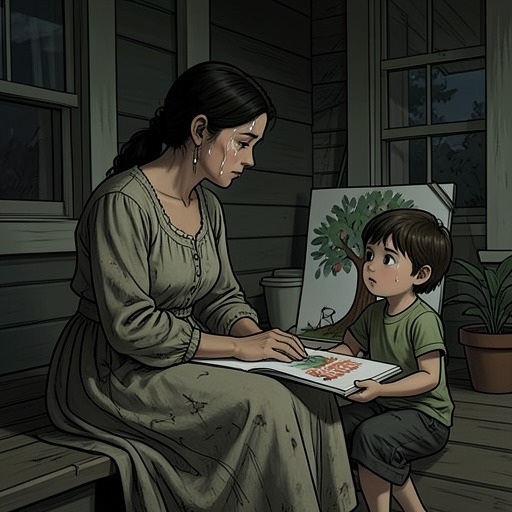
Where the Crawdads SingThe Kya Clark–Ma relationship is defined by a separation that Kya experiences first as abandonment and later reinterprets through painful new knowledge. Ma left her children in a home made dangerous by their father; years afterward, Kya learns that Ma loved them, had tried to reach them, and believed returning could expose them to violence. The revelation makes forgiveness possible, but it does not restore the relationship or erase Kya’s unanswered question: why did Ma never find another way back to her?
Separation and the search for an explanation
As a child, Kya is left behind when Ma walks away from the family. The separation is not a brief absence with a known end: Kya grows up without news of her mother, and her father’s later disappearance leaves her isolated from her family altogether. The missing explanation becomes an enduring question. Once she can read, she searches through biology for a reason a mother would leave her offspring, bringing her own loss into her study of nature.
Her observations offer examples of life organized around survival rather than human ideas of fairness. One night, watching fireflies, Kya sees females alter their signals: after attracting a male of their own species, one changes her pattern to draw a male of another species, then seizes and eats him. Kya understands the event not as evil but as a biological strategy. This way of seeing does not answer what happened in her family, but it establishes a framework in which behavior that looks cruel may serve survival without becoming morally simple.
Later, a scientific digest on reproductive strategies gives that framework sharper language. Its account of weaker male bullfrogs using deceptive signals to mate while a dominant male is occupied recalls the remembered warning Ma gave her older daughters about young men who made a show of themselves. The digest also describes dishonest mating strategies as ones that often leave males alone. Kya takes consolation from that account, but her reading does not turn biological explanation into a substitute for personal history: the question of her mother remains unresolved until Jodie returns.
The news that Ma died
When Jodie Clark finds Kya, he brings news about both the living and the dead. He does not know what became of their other siblings, but he has learned that Ma died two years earlier. Kya bends forward, covers her face, and groans; when Jodie tries to hold her, she moves away. The news collapses two possibilities at once: Ma will not return, and the long wait for an explanation can only be answered by someone else’s account.
Jodie explains how that account came to him. After Ma died, her sister Rosemary tried to locate the children through the Red Cross, but they could not be found. Ma’s father had also contacted the sheriff in Barkley Cove to ask whether the children were safe. The sheriff’s office said it did not keep track of people from the marsh. The family’s separation had therefore been compounded by a failure to search for or account for the children, leaving Ma’s relatives unable to reach them.
Jodie himself was eventually found through the Army and connected with Rosemary. Through what Rosemary told him, Kya learns that Ma had spent months mute in her childhood home, barely eating and staying in her old room. Doctors came but did not help. Nearly a year after leaving, Ma became hysterical and remembered that she had left her children. With Rosemary’s help, she wrote to their father asking to come and take the children to live with her in New Orleans.
The letter and the danger of returning
The reply made the prospect of reunion dangerous. Their father threatened to beat the children unrecognizable if Ma returned or contacted them, and Ma knew he was capable of carrying out the threat. Kya had encountered the consequences of that correspondence earlier without knowing its meaning: the letter’s words enraged her father, sent him back to drinking, and were followed by his own departure. She had not known that Ma’s attempt to reclaim the children had been met with a threat against them.
This disclosure changes the emotional shape of the letter. It had not been evidence that Ma had forgotten the children or chosen a life elsewhere; she had tried to bring them to safety, then faced a threat that made returning seem likely to expose them to harm. The explanation does not make the separation harmless. It does, however, replace the image of simple rejection with a terrible conflict between two dangers: leaving the children without her, or returning and risking their father’s violence.
Love, illness, and the limits of forgiveness
Rosemary’s account also gives Kya a picture of Ma’s life after the failed attempt to reunite. Ma made no friends, did not dine with the family, and took no pleasure in ordinary life. As she began speaking more, she spoke about her children. According to Rosemary, Ma loved them throughout her life but remained trapped between believing they would be harmed if she returned and believing she had abandoned them if she stayed away. She had not left for an affair; she had been driven into a state in which she barely understood that she had left.
Ma later developed leukemia. Rosemary believed it might have been treatable, but Ma refused medication, grew weaker, and died in darkness and silence. Her death gives the separation a finality Kya had not known to expect: Ma had been alive until two years before Jodie brought the news, yet Kya had continued waiting for her to come down the lane. The fact that Ma lived for years without returning makes the explanation more complicated, not less. The danger explains why the first attempt failed, but it cannot tell Kya why Ma never wrote again or sought another way to reach her.
Kya names that distinction when she speaks with Jodie. She says she has lived isolation, and she can forgive Ma for leaving while still failing to understand why Ma did not come back or keep writing until a letter reached her. She considers whether stress and danger may activate ancient survival instincts: in some animals, a mother’s abandonment of offspring can increase her chances of surviving to raise young later. Kya extends this possibility to human behavior, imagining that fear of their father may have driven Ma to leave. But she refuses to treat a biological account as a moral acquittal. In her understanding, it may help explain the departure; Ma should still have chosen to stay.
The relationship ends not in a reunion between mother and daughter but in a belated act of reinterpretation. Kya receives evidence of Ma’s love and terror only after Ma is dead, through Jodie and Rosemary. That knowledge loosens the certainty that she was simply unwanted, yet it cannot answer every question or undo the years of waiting. Forgiveness becomes a way to hold both truths together: Ma may have been profoundly afraid and profoundly loving, and Kya was still left alone.